Flexible Coupling Leakage: Common Causes and Practical Prevention Tips
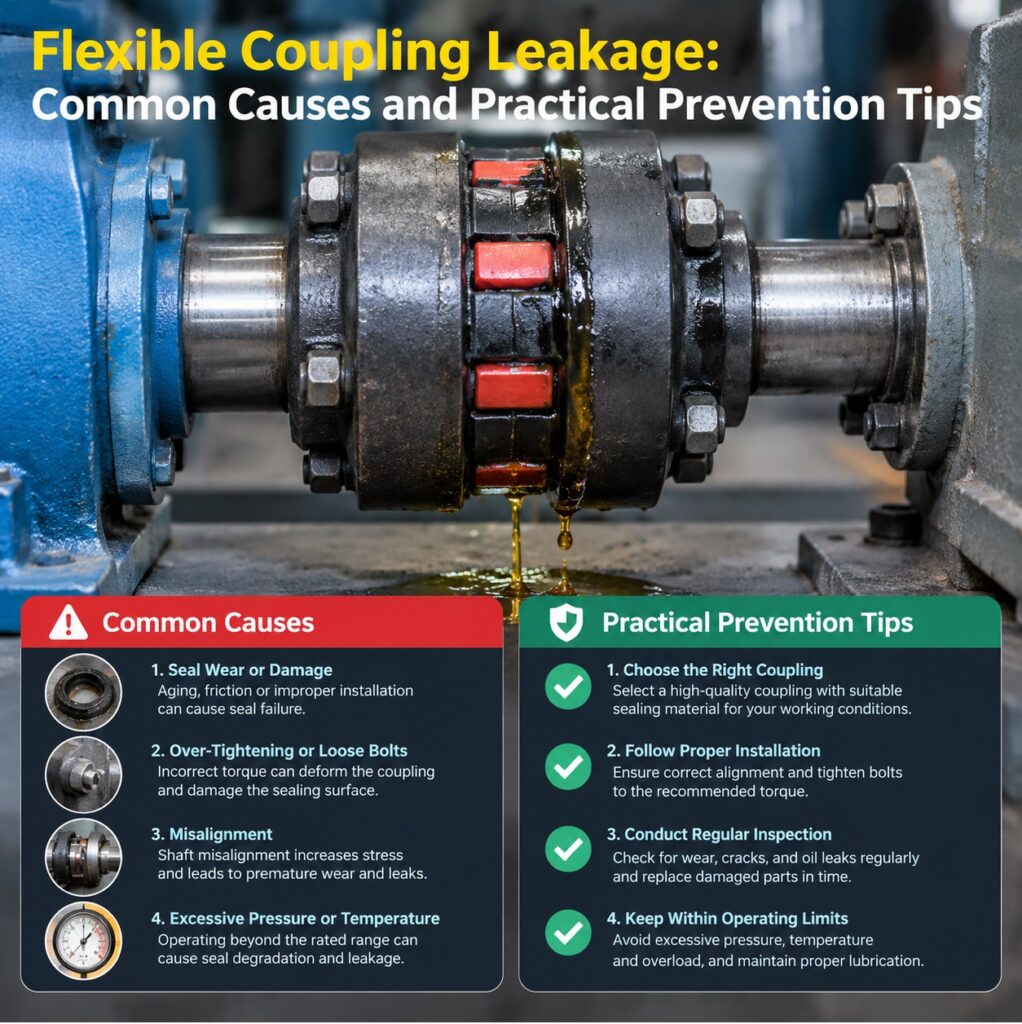 A flexible coupling rarely leaks because it hates you. It leaks because something in the assembly is working harder than it should, or because a small installation shortcut has finally come due.
That distinction matters. Most leaks blamed on the coupling itself start somewhere else: misalignment, over-torqued bolts, a support that walked away, the wrong elastomer for the fluid, or a pressure spike nobody saw on the gauge. The coupling gets the blame because it is the part with the drip hanging off it.
If you maintain pumps, piping, or process equipment, here is what to look for and how to stop repeat failures.
Cause one: Misalignment that never really left
A flexible coupling can absorb some misalignment. It cannot absorb a pipe run that is fighting itself. Angular offset, parallel offset, and twisted flange faces all load the sleeve, gasket, or sealing element unevenly. The leak often appears at the point of highest strain, not the point where the alignment error started.
Prevention starts before the bolts go in. Check flange faces. Bring pipe ends together without forcing them. Use laser alignment or dial indicators where the application demands it. If you need a pry bar to close a gap, you are not installing a coupling. You are pre-loading a leak.
Cause two: Bolt torque and uneven clamping
Too loose, and the seal never seats. Too tight, and the elastomer or gasket crushes, splits, or takes a permanent set. Uneven torque is worse than either. One side of the coupling does all the sealing while the other side watches.
Use the manufacturer’s torque sequence and values. Do not trust the impact wrench and a feeling. Re-torque after the first heat cycle or pressure cycle, because materials relax. A coupling that leaked after three days often was not defective. It was simply never rechecked.
Cause three: Wrong material for the medium
This is where bargain shopping gets expensive. A rubber compound that handles water may swell in oil. A standard gasket may turn brittle in acid. A sleeve rated for ambient temperatures may soften and creep near a steam line. The leak is not a mystery. It is chemistry.
Know the fluid, concentration, and temperature. Check compatibility charts, but do not stop at the headline. Look at the actual compound, not just the generic material name. If the line sees cleaning chemicals, caustics, or intermittent solvents, say so. The coupling has to survive the worst day, not the average one.
Cause four: Pressure and temperature outside the comfort zone
Every flexible coupling has a pressure-temperature envelope. Exceed it, and the seal element deforms, extrudes, or loses clamping force. Water hammer and surge events are especially nasty because they spike pressure far beyond the steady-state reading. A gauge that shows 80 psi at lunch may not show the 200 psi slam at valve closure.
Prevention means sizing for surge, not just operating pressure. Install surge protection where needed. Use a coupling with the right pressure rating and temperature range. If the line runs hot, account for thermal expansion. If it runs cold, account for contraction and material stiffness. The coupling should be the flexible point, not the weakest point.
Cause five: Poor pipe support and vibration
A flexible coupling is not a pipe hanger. When supports are missing, loose, or badly placed, the coupling becomes a structural joint. It takes weight, vibration, and thermal movement it was never meant to carry. Cracks and leaks follow.
Support the pipe independently on both sides. Leave the coupling free to do its job. Check for pump vibration, cavitation, and loose anchors. If the coupling is pulsing or visibly moving more than expected, fix the system, not just the drip.
Cause six: Installation damage
A scratch on a sealing surface can be enough. So can a folded gasket, a contaminated flange face, or a sleeve nicked by a screwdriver. Many leaks are born during maintenance and show up later, usually after the crew has moved on.
Clean mating surfaces. Inspect the coupling before installation. Lubricate only with the manufacturer’s approved lubricant, and only where specified. Keep weld spatter, grit, and old gasket residue out of the joint. If the coupling uses clamps or rings, make sure they are seated square and not pinching the sleeve.
Cause seven: Age, creep, and hidden wear
Flexible materials age. Heat, ozone, sunlight, and chemical exposure take a toll. Elastomers creep under constant load. A coupling that passed inspection last year may be near the end of its useful life now.
Build inspection into the maintenance schedule. Look for swelling, cracking, hardening, soft spots, corrosion on metal parts, and loose clamps. Replace wear parts before they fail. Keep spare couplings on the shelf, but keep the right ones. A generic replacement that fits the pipe but not the service conditions is just a future leak with a part number.
Practical prevention that actually works
Start with the line conditions, not the catalog price. Match the coupling to the fluid, pressure, temperature, movement, and vibration. Buy from a supplier who gives you real torque specs, material data, and installation guidance. That is not a luxury. It is how you avoid turning a small leak into a shutdown.
Train the installers. A coupling is not a gasket with a fancy name. It has a direction, a torque sequence, and a tolerance for movement. Get those wrong, and the best coupling on the market will still leak.
Then inspect. Re-torque. Support. Align. Repeat. The plants with the fewest coupling leaks are not lucky. They are boringly consistent about the basics.
If you are tired of chasing drips, stop treating flexible couplings as disposable hardware. Treat them as critical sealing components. The right selection, the right installation, and a little preventive attention will keep your process dry, your maintenance crew calm, and your uptime where it belongs.